• Home
My Blog

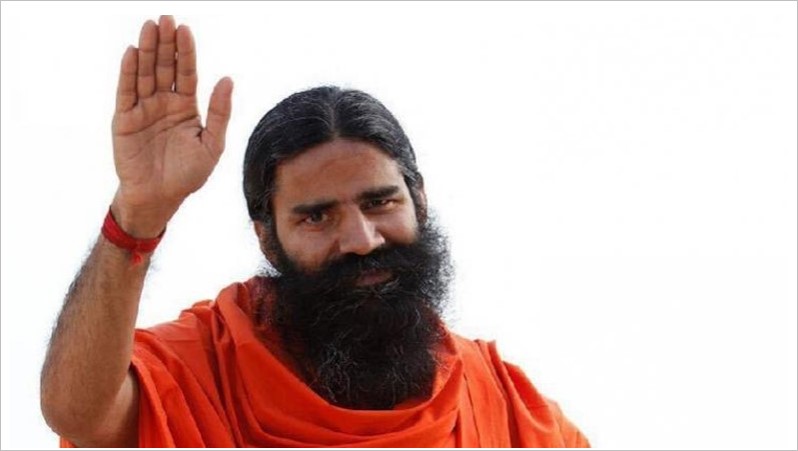
Why Swami Ramdev Deserves our Respect & Support?

by ds_admin September 22, 2021

Two years ago on June 4th, at Ramlila Maidan, Swami Ramdev (a Sadhu) and his supporters (Innocent public), while peacefully fasting against corruption and black money, were beaten, many of them arrested. The scale and significance of this FACT is too big for any Indian and Hindu to forget.

It was once again a big reminder to all of us that we are still ruled by centuries old laws, laws that were made by foreigners to control us, to wield muscle power on us ruthlessly, in the guise of some rule. Every human being, howsoever disabled or passive, has the potential to disrupt the peace, so just being alive is reason enough to arrest & beat anyone (even a dead man can be a threat to the peace but then, it may not be much of a use to beat & arrest him).

After this incidence, cases were filed against Swami Ramdev and his organization, investigations were carried out on his money trails, media spent lot of time highlighting those cases and making up negative stories about him.

They even found many small time Yoga teachers who questioned Ramdev’s ways of teaching Yoga. Lured into the trap, many common people started questioning his riches – why does he have so much money if he is wearing saffron clothes. There are few other things people thought about him, mainly about this vested interests – what does he want, isn’t he too ambitious?

We have seen many times politicians delivering stupid speeches in industry associations, and none of the industrialists ever says a word against the speech or the speaker, irrespective of the political party the speaker belongs to. If you want to run the business smoothly, don’t be at bad terms with any politician, it’s the basic law of the business. You can be especially closer to some party, but don’t be far from other parties. If Swami Ramdev’s priority was making money, he is smart enough to know this. The fact that he openly announced a movement against the most powerful people of this country, its clear money is not the only thing he wants.

Does he want power? Before he started speaking against the black money and national issues, he was liked equally by all political parties. Looking at his popularity in those days, he could have become an active role player in any political party. In other words, he could have become a king maker even without confronting with the existing system and this system’s key players. Life would have been easier that way – have your say in the corridors of power, remain popular with the masses through Yoga, make huge money through Divya Yog pharmacy products, no investigation of money matters and taxes, no scrutiny of products, everything rosy-rosy. It would have been a dream run. Sailing against the stream now, is he just too adventurous?

Why is he so rich – we are okay when we know industrialists make money by violating laws, or rather getting laws changed in favor of them. But we cannot see a good man having good amount of money. If someone is honest, if he is talking good things, he must be poor. Being poor means that you are honest probably because there seems hardly a way to make good money by fair means. Another reason why we don’t like saffron with money is a deep rooted tradition. Varna system of ancient India was based on the distribution of power. In Varna system, there are four pillars of power: Knowledge, land, money and muscle power (army). Our forefathers knew that if any particular group of people has more than one of these and he becomes immoral, he can have too much power that can imbalance the society. So they made such a system that no one should have more than one of these four sources of power. This is one of the key reasons that we don’t like saffron clad people with lot of money. But in today’s scenario, when all power is with political systems, its unfair to expect a poor man to bring a positive change, that too as a leader. Only to travel to different places to awake sleeping people, one needs big money.

More than two years back, when Swami Ramdev announced that he and his supporters will fast against corruption at Ramlila ground, many thought that he was competing against Anna. Anna was very popular and it seemed that Swami Ramdev did not want to be left behind in fight against corruption. No doubt we need all kinds of forces to act against this deep rooted disease and the efforts of any individual/organization are no less important than others. Looking at the vision of Swami Ramdev, he wants to attack not only corruption, but wants to bring overall change in the system comprising Education, health, legal, economy, agriculture – an overhaul that should have been done immediately after 1947. It’s not limited to few men surrounding him talking about this big change, he has been trying to disseminate this message to every village, every town so that a common man feels the need of this change. Its no easy job, considering that all media is being manipulated by people in power. All mainstream information is meant to make us believe that the only way to live is by consumerism & capitalism. We Indians are systematically made to believe that as a nation India is too inferior to give a prosper & meaningful life to every citizen unless we follow these western systems imposed on us. Swami Ramdev’s efforts may not do a big bang overnight, but are sure to start a silent revolution that will surely show results in due course. Even if you are not a big fan of him, you have to admit the courage with which he is defying the norms of the world order and at least propose an alternative way an indigeneous way to live. We have choice, we can keep floating with the stream, which even a dead wood is naturally inclined to do. Or take a pause and spend a minute to introspect and pay attention to Swami Ramdev’s effort who is making an effort to swim upstream.

If you cut through all the noise, as an Indian or as a Dharmic (read it genuinely secular) person, think about these basic questions:

  • Has Swami Ramdev done anything unpatriotic?
  • Has Swami Ramdev done anything against the common good of society?
  • Shouldn’t all influential people in society do their shared of social service? How many Sadhus you know besides Swami Ramdev, who are working to improve social system?
  • How many spiritual leaders you know, even in History, who have built strong organizations besides contritbuting to spiritual knowledge?
  • Haven’t “Lakhs & Crores” benefitted from Swami Ramdev’s personal and Patanjali Yogpeeth’s effort?

Yes, numerous people have benefitted due his personal effort.

I say he is a national hero, he is a revered Sanyasi and deserves sincere respect and support of the society, let alone our passing attention.

Author: Sunil Sheoran

Published: June 4th, 2013
September 22, 2021 0 comment
0 FacebookTwitterPinterestEmail

Two Dharmic-Patriots & a Letter

by ds_admin September 22, 2021

If we had a genuinely secular and patriotic media Swami Ramdev and Shri Rajiv Malhotra would make headlines every other day. Instead the media continuously strives to fill our mind with unimportant things with undue glamorization. Imagine, if we take out all the following items, how much mental space media can save us?

  • Bollywood
  • Cricket
  • Political bickering
  • Making us feel that Indian traditions are inferior to foreign ideologies and lifestyle

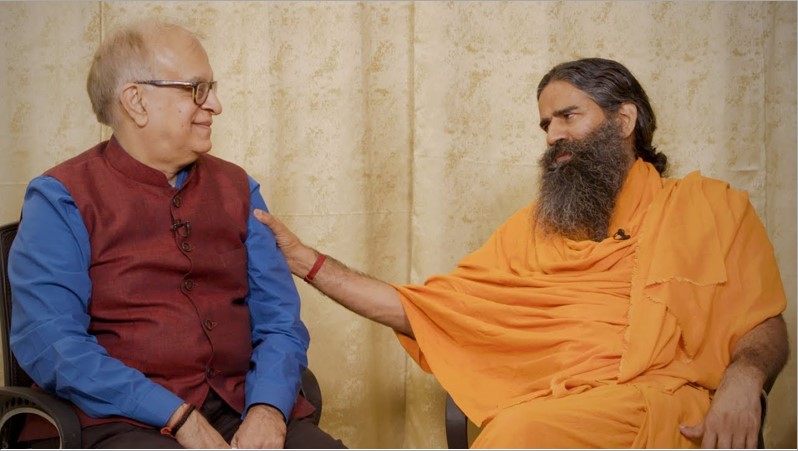
Recently, Swami Ramdev wrote a glowing endorsement letter for Shri Rajiv Malhotra. The press release (including the copy of the letter) from Shri Malhotra’s Infinity Foundation can be downloaded here. This important news, lost in the sophisticated world of mainstream media, we celebrate it in Jagrit-Bharat circles. Let’s reflect on why these prominent Dharmic-Patriots of current times, deserve our society’s respect, let alone attention.

The idea of Dharmic-Patriots
Commonly the mainstream media classifies ideologies as left, right and center. Indian civilization being a Dharmic civilization, a better classification would be Dharmic ideology versus the others. One of the most unfortunate things that has happened to India, is the degradation of word “Dharma” to “Religion”. The concept of Dharma versus religion is very well explained in Shri. Malhotra’s book “Being Different”

Two of the key concepts of Dharma are “inclusiveness” and “the common good before the personal gain.” The second concept of “the common good before the personal gain” is pretty self-explanatory, the idea of inclusiveness requires a bit of explanation. Dharmic ideology is anchored in “Live and Let others live happily – even when others have a differing belief system”, whereas the religious thinking is always uncomfortable with differing ideologies. To patch up this uncomfort among religions, secularism plays a crucial role to separate governance from the religious beliefs. Dharmic ideology has an inherent “genuine secularism” in its ideology. An externally enforced secularism, which typically is manipulated by people in power, creates new problems as opposed to making the society better. Today, patriotism anchored in defending the sophisticated ideology of Dharma has taken backseat due to a variety of reasons.

In the society today, be it leading thinkers or the common man, a very small number of people are able to comprehend the depths of the Dharmic ideology. Swami Ramdev and Shri Malhotra are two of the pioneers in current times, who have taken upon themselves to explore the depths of philosophy, synthesize the Dharmic understanding and then bring along the masses to defend Dharma. In the times when world is interacting in complex ways, when information can instantaneously travel globally, when the forces against “Dharmic-Patriotic” ideology are heavily equipped with powerful capabilities, the task for Dharmic-Patriots might seem insurmountable. These two Dharmic-Patriots are defying all odds and deserve our support in every way possible.

In praise of Swami Ramdev:
I don’t intend to market all the accomplishments of Swami Ramdev. Here’s some thoughts for you to ponder.

  • Sanyasis typically focus on spiritual development of the individuals – that’s our tradition. Understanding the needs of the current times, Swami Ramdev has broken this mould and has taken upon himself to build tangible solutions for a better society. I’d say, separate out the personal spiritual benefits to an individual, which can never be proven conclusively and then compare him with other religious leaders. Think, how many other religous leaders…
  • Provide “healthcare” products and services? Swami Ramdev’s organization can be credited for renaissance of the ancient science of “Ayurveda”
  • Provide practical solutions to social challenges at ground level as opposed to sadhus lecturing in their ashrams? Please don’t misinterpret this, as a criticism of genuine saints whom we revere.
  • How many Sanyasi have built strong “institutions”? Exploring the depths of philosophy itself is all-consuming; building institutions requires a very different set of capabilities, and Swami Ramdev is a unique great one to pull off, both sides effectively.
  • Who else besides Swami Ramdev has taken upon himself to clean the dirty politics of country, when he could have enjoyed a comfortable life with all politicians, bowing to him?

In praise of Shri Rajiv Malhotra
In contrast to Swami Ramdev, Shri Malhotra is a householder, lives in New Jersey, USA and defending Dharma at Global level; primarily in North America. Thinking about Shri Malhotra’s unique positioning and contribution, these  thoughts come to mind:

  • Typically, one gets consumed in the culture, where he lives. In contrast, Shri Malhotra, lived in west almost all his adult life as an authentic Indian. He not only thrived professionally, but at the peak of his career gave up his personal millions of dollars to live a simple life and serve Dharma. Think about it, who else you know in current times, has made such a personal sacrifice?
  • His contribution, is not just his “material wealth”, he invested his “full time for two decades” to do scholarly work to understand the depths of Dharmic philosophy. His research & scholarly work, is so “high quality” that it has withstood and “won” scholarly critique and media debates over the years. Even the top professors, who get paid a salary to do the same job, haven’t produced such high quality results.  Think, who else you know has done such a disciplined research?
  • Think about the courage it takes, in defending culture when the mindset all around is dominated by western lens.
  • Just like Swami Ramdev, Shri Malhotra has also stayed above politics, and has anchored his work in Dharmic ideology to serve humanity
  • His four unique knowledge contributions, if adopted properly, can change the course for Indian society & Dharma in years to comes:
    1. Being Different: Provides a unique interpretation of Dharma, defends it against other religious ideologies and proposes the idea that we need to look at the world from Dharmic frame of reference as opposed to western lens.
    2. Breaking India: Provides a wake-up call to sleeping Indians about the anti-India forces that are at work to break India. He warns that it’s a real possible future that our country gets split in pieces, if we don’t take right action.
    3. Invading the sacred: Demonstrates how the mature philosophy of Dharma is being ignored and misrepresented in education systems in the most respected society today “United States of America.”
    4. 20 volume series on Indian Science & Technology: Provides a robust basis for defending India’s contribution to the world and building self-esteem in Indians by connecting with tangible aspects of our great heritage.

India would rebound so fast if Indians can grasp the ideas of these two wise men, in their personal lives, in building laws & governance institutions, and organizations that complement the government institutions. That envisioned future just seems a fantasy, as of now. Yes of course, I respect both Swami Ramdev & Shri Rajiv Malhotra. When it comes to Dharmic or national level issues, the personal biases should be irrelevant though. Critique my opinion with your own analysis to make up your mind on the issues related to Dharma and our country. I do appeal to all Dharmic-Patriots to support these two pioneers and do your own share of contribution for a better India and better world.

Download the hand written letter of Swami Ramdev in Hindi, which reads better than English translation. We’ve copied the English translation here, which is also included in the Infinity Foundation’s press release. 

“OM

Shri Rajiv Malhotra is doing a stellar Job of evidentially establishing the universality and scientific truth of Indian Vedic Hindu Dharma on the world stage.

For the past many centuries, attempts are made to denigrate, malign and destroy the Sanatan Arya civilization through political clout, financial muscle, media and other propagatory means, universities, writers and other influential persons, by anti-Hindu forces and other scheming powers.

In a constant effort to humiliate us, false accusations are being hurled at our Rishis, Munis, Dietes and Mahatmas through the collusion of European-based and America-based anti-India and anti-Hindu forces, powerful churches, anti-Hindu universities and obscure forces and conspiratory organizations. On the contrary, the fact of the matter is, that communities and religions born on foreign soils lack the scientificity and universality as are inherent in Hindu Dharma.

In our Vedas and Vedic literature, our forefathers have – scientifically and evidentially – studied, researched and expounded on the matters of Jnana-Vijnana, technology, vastu, arts, dance and music, astrology, grammar, mathematics, geography, astronomy/ astrophysics, on subjects ranging from worldly prosperity and spiritual advancement to all fields of study of microcosm and the macrocosm.

Shri Rajiv Malhotra is the only person to have challenged the non-Dharmic forces, on the combined bases of reasoning, fact, strategy and evidence, and has firmly established the authority of Dharma in the West. We Indians are proud of Shri Malhotra and consider him as among our finest.

Our best wishes and blessings are with Shri Malhotra and it is impossible to eulogize him in words, for words have but limited adequacy. Through your agency, may the glory of Hindu Dharma be ever-expansive.”

– Swami Ramdev

Author: Sunil Sheoran

Published: July 23, 2013

September 22, 2021 0 comment
0 FacebookTwitterPinterestEmail

Christmas Enthusiasm Among Hindus

by ds_admin September 22, 2021

On December 24th, right after breakfast, one of my old time college friends Amit (name changed) called and started laughing in his peculiar way, as I picked up the phone. Obviously I asked “What happened?”

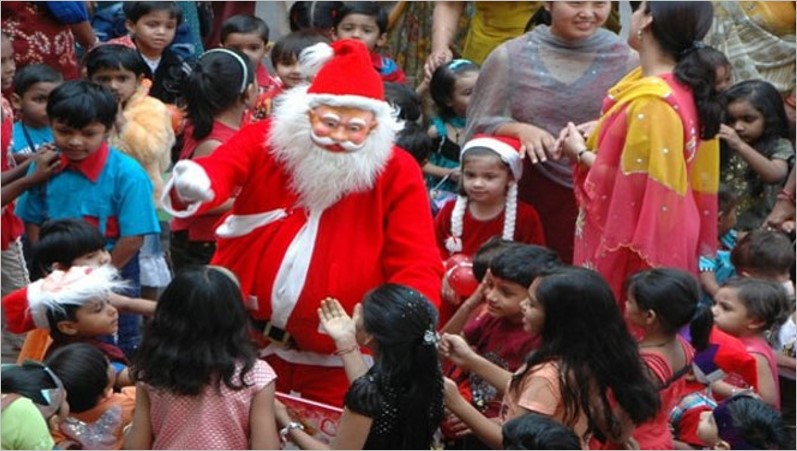
Another college friend of ours, Sumit  (name changed), typical nice Desi boy, who came  to America about 15 years ago had a sent a picture of himself dressed as Santa Claus to his mailing list. A common Christian friend, who received the over-enthusiastic Christmas wishes, called Amit to understand why would Sumit do so, when he’s not Christian? She could not figure out, how a non-Christian is so enthusiastic about the festival. She was honestly CONFUSED.

Our conversation swung between inside jokes of friends and extracting humor out of people’s silly behavior in cross-culture interactions. Later, I thought to do an experiment on Facebook to see how people would react if I say that “Hindus wishing Merry Christmas to each other is a silly behavior” and I spiced it up with some straight shooting words “stupid behavior, colonized mindset.”  Just so happened, my wife (who’s out of town right now) posted a similar note on her Facebook profile.  The interactions with our friends, gave very good insights into minds of a variety of folks from close friends to casual acquaintances… which is pretty good representation of mainstream Hindu mindset, at least the urban Hindu mindset. I called a couple of friends in India to check on how’s the Christmas celebrations there, and brainstormed on Hindus’ enthusiasm for Christmas. As I was thinking through this seemingly mundane Facebook social experiment, insights into current Hindu mindset were not pleasing – hence this article.  I hope to trigger some introspection among some “thinking Hindus.” While the analysis started with the topic Christmas Enthusiasm among Hindus and it ended up being a survey report on current state of mainstream urban Hindu mindset. Enjoy, critique and expand on it for your own good.

 So here it goes…

 BASIC  KNOWLEDGE REQUIREMENTS FOR THE CURRENT TIMES

I’ll make arguments later in the article based on some basics (really basics) about Hinduism/ Sanatan Dharma, and what a world aware person should know in the current times of globalization.  In my view, here are the minimum 3 things every educated Hindu should understand:

  1. Have essential understanding of Hinduism: Know the basic philosophical foundation (E.g. God’s/ Our divinity, Reincarnation/ Karma, ability to spiritually evolve oneself etc.), and a bit more about your own chosen path. While there’s a variety of interpretations and differences in traditions, still the conceptual foundation is pretty much same. So there’s no need to look down upon others’ paths, which are also “valid/ viable” ways to realize the metaphysical truths.
  2. Know that there are two major buckets of philosophies in the world: Dharmic versus Abrahamic. Within Dharmic traditions (Hinduism, Sikhism, Buddhism, Jainism…) the philosophical differences are minor, but there are serious philosophical differences with Abrahamic traditions (Judaism, Islam, Christianity…). While a common man doesn’t need to dig into philosophical differences, everyone should be aware about practical ideological differences that matters in everyday life – “exclusivity and expansion.” Exclusivity means that all Abrahamic traditions believe they are the ONLY VIABLE WAY to realize the metaphysical truths (which are not same as Dharmic version) and it is responsibility of the believers of that tradition to contribute in “expansion” of their faith. Mind you, it’s not the belief of an individual that matters; it’s about what organizations that represent Abrahamic religions officially declare. For the expansion, Abrahamic religions need to have machinery (institutions) with some sort of a plan. I’m not saying this ideology of “expansion & exclusivity” is good or bad; but it is sad fact that so many of Hindus are not aware of it. It might be the world’s biggest irony that Hinduism philosophy is most open & accepting of other ideologies; and in current times Hindus are the least assertive. Other religions discuss their exclusivity as well as their expansion plans, openly and comfortably.
  3. Know that it’s a competitive marketplace: It always has been! Historically, Abrahamic religions have been gaining the market share. Neither Islam, nor Christianity existed 2000 years ago. Here’s some current data on religions of the world: http://en.wikipedia.org/wiki/List_of_religious_populations . So know that it’s not an issue only between “You and God”, competitors are working to gain YOUR mind share – with a strategy backed with institutional assets. So everyone must be consciously aware that religion goes beyond “personal & private.” It’s also about control and power; both soft and hard power. Soft power is about influencing your thinking, and hard is about controlling laws/ governance, money, land/ natural resources etc. At least be aware that organizations do exist and are working with clear mission and goals. Another key point is: Leaving aside the reasons, know that Dharmic institutions are not run as effectively as Abrahamic institutions.

Using these above mentioned requirements, think about yourself, the people around you and quality of Hindu institutions you’ve interacted with!

Although I haven’t answered here explicitly, but you might have caught that “Dharma” and “Religion” don’t mean the same thing. Also, you better know which team you are in, even if you have no desire to play a socially important role. You may very well be an atheist, all I’m saying is that be actively conscious of it for your own sake, and the for the sake of your family. In some way, everyone has to deal with these issues, sooner or later. You may very well choose to be a spectator, as opposed to being an active player in this game of inter-religion influence. But if someone doesn’t have the essential understanding I’ve highlighted above, in my view he/she is not well qualified for inter-culture interactions. Even among Hindus they should not be allowed to have a significant voice. It’s like blind leading the blind.

Coming back to this week’s example…

EXTRACTS FROM FACEBOOK INTERACTION

In my Facebook post I provided the context of friends Amit-Sumit and essentially mentioned that if it’s only among Hindus you are stupid and colonized to celebrate Christmas enthusiastically. My wife’s post essentially said, I’m a Hindu and I celebrate Diwali, Holi etc. I’m not a Christian and don’t celebrate Christmas, so dear Hindus please don’t wish me Merry Christmas.  We clarified that it’s about defending our tradition, at least in our own home, and not about encroaching the competitor’s turf, let alone hating other religion, which no true Hindu would do.

I’m sharing some extracts and my counter arguments/concern with our friends’ thoughts and arguments. Obviously, the reason for this is to trigger introspection among our community and learn as much as we can. I agree, many of our friends wrote comments casually. I see the casual communication as good, because it is more candid, and it shows what’s in the subconscious mind. Note that, these comments are from our “friends and family” who tried to be nice and polite and are just having a healthy conversation. Imagine the conversation if it included strangers and adversaries! Remember, requirement # 3 above… it’s a competitive marketplace!

I’ll make one or two comments in terms of my “concerns” to friends’ arguments and collectively these concerns should worry anyone who cares about future of Hinduism.

To my friends whose comments I’m borrowing: My “concerns” are not a response to you. I’m only using your thoughts to build a collective list of issues for our community at large.

  1. Merry Christmas to you and family. ANOTHER ONE: hope this is just a fleeting feeling. ANOTHER: As  kids we wished each other merry Christmas on Christmas but nobody changed their religion … Nothing wrong in wishing someone on a holiday…don’t think too much into it …. Enjoy
    CONCERN: Avoiding the issue of substance, and trivialize by humor/ teasing. Also, reconfirms the mindset that we all just vent out emotionally, so it discourages a solemn conversation. It’s like we did not change our religion, so let’s be complacent in competitive marketplace. Also laziness: Take it easy/ “Chalta Hai” attitude
  2. What’s the problem in taking first steps. All the markets celebrate Diwali – isn’t it. Whatever the religion of shop owner. Trust it just marketing. So enjoy
    CONCERN: Person is clueless about competitiveness among religions and still confident of his opinion. Does a competitor exist? Has he thought about what a competitor would do in what situation?…just clueless
  3. We celebrate gurpurab jointly. And for every one to know that when we do hawan and puja at home our Muslim friend do. Attend.
    CONCERN: It’s not about “individuals,” there are good people in every religion. It’s about philosophy, and about institutional strategies to gain market share. Friends participating in other friends’ rituals is NOT the issue. Gurpurab anyway is a Dharmic tradition, and within Dharmic traditions, we should encourage cooperation, not competitiveness…Shows lack of understanding on the three requirements mentioned above.
  4. Why don’t we dress doti Kurta and pagri. why we wear suits.
    CONCERN: Assumes I’m a backward thinking person who wants to live in some fixed historical time. Can we Hindus answer today, how do we advance/ become modern (make progress in Hindu way), without westernizing?
  5. I do not see any problem in appreciating Eid, Diwali, guru purab and Christmas. All 4 religion are well represented in India.
    CONCERN: Represents lack of understanding the 3 requirements above and shows laziness in thinking, copy/paste of a slogan sentence. Unable to grasp point of “Hindus brainwashed to celebrate a competitor’s festival, even when competitor is not working on it with direct involvement.”
  6. Religion is the root of a lot of problems in the world. Be spiritual not religious !!!
    CONCERN: Most people I’ve talked are unclear on the basic words “Dharma,” “religion”, “spiritual” in the context of comparative religion. Another example copy/paste of slogan sentence… without thinking.
  7. Besides the religious aspect of the holiday, there is a huge cultural aspect to it. Christmas is a big part of North American culture. Amongst other things, we get days off of work and school to spend with our loved ones, so the day has become special to us too… Great- more joy for all. ANOTHER ONE: Christmas is one of my favorite holidays in the US. Christmas to me is having my family at an arm’s length. It is a time of joy and love. It is the only time when everything comes to a stop and we enjoy the quality time with family and friends. I don’t celebrate it as Jesus’ birth but more as a season of giving. I’m proud to be an Indian, and I’m proud to be a Hindu, but foremost I’m proud to be a loving and nurturing human being. I love the spirit of Christmas. I love the jolliness of the season. ANOTHER ONE: I’ve never felt confused being a Hindu and celebrating a Christian holiday. We celebrate all the festivals: Indian and American. I put up the Christmas tree and decorations, and we exchange gifts. Why shouldn’t I celebrate a holiday that brings so much joy and happiness to my family?
    CONCERN: This is a valid point, Christmas has huge cultural value in North America and religious aspect just gets sneaked in.  It is harder to grasp “expansion” when religion is wrapped in commercial & cultural aspects. In India a significant amount of money is being spent to build this wave. We are half way (don’t take literally) in digestion process and completely unaware. Obviously, many of us don’t even know that, the digestion doesn’t happen instantly, it may be a multi-generation process. (Consult the book Being Different for details of digestion)
  8. Hon… yes we must not confuse our children, we must teach them to be tolerant and accepting of all religions, beliefs and festivals… as long as it doesn’t harm us in any way (which I don’t believe it does) why not just be part of the festive spirit… Humanity should be our religion and how we choose to celebrate it w/ our loved ones, a matter of choice…
    CONCERN: Mindset to live in “fairy land/ goodie-goodie world” and staying disconnected from competitive marketplace. Unless we anchor our kids solidly in our own tradition, why would they not get digested?
  9. I’d like to point out that you can be Hindu and believe in Jesus. Maybe not as the Son of God, but there is nothing that says you can’t believe he existed. Source: Arsh Vidya Gurukalam in Sailorsburg, Pennsylvania
    CONCERN: This is a good one. I know for a fact that Arsh Vidya Gurukulam believes in being a traditional Hindu and resists digestion. Here the concern is about the transfer of context and using the words of a credible source with completely opposite intent.
  10. Who told you we have many gods , you know God is one, christian call him Jesus, Muslim call Allah , and we have so many God .take there blessing and live happily ever after . We celebrate Diwali holi and Christmas it’s time for joy ,happiness share your joy
    CONCERN: This is a good one, because an elderly grandma is saying that.  The root of this issue of dissociating from our heritage started with prior generations. The big damage happened with colonization during British time. So it’s important to understand the importance of “unlearning” and “cleaning the collectively polluted mind” we’ve built in about 200 years.
  11. Come to Bangalore at least you will get some answers on this complex issue!!!
    CONCERN: The problem in not in infancy, it has already become big enough and is growing rapidly. Come to metros and validate!!!
  12. Please go and watch PK movie. You might find answers to your question.
    CONCERN: Many of us honestly believe that “Hinduism” has too many bad things in it (while we have hard time finding anything bad in competitors), so no pride, no commitment, even no reason to defend it.
  13. I think you are misunderstanding the concepts of Christmas Day.
    CONCERN: We start preaching on the subject that we are not experts. We don’t even recognize that “comparative religions” is a body of knowledge; which requires study like engineering or medicine and then practice for a few years, before you can start playing in field against competitors with sophisticated plans. Otherwise forget about winning; today, most Hindu “leaders” just run away when tough issues come up in competitive marketplace.
  14. This is how hindus have been since centuries…….we accept and respect other religion…….if we will start pushing our kids forcefully to follow hinduism then what is the difference between us and muslims…….
    CONCERN: Yes, we have been around for centuries. But you assume that our ancestors were complacent and silly like today’s Hindu community. Our significant cultural degradation has happened with British intervention and thereafter. Think, how much we’ve lost, both in hard power as well as soft power since then.
  15. Hinduism is an umbrella term for the people who actually practices thousands of paths, culture and tradition and sometimes these cultures and traditions contradicts each other. It’s more like culture than a religion.  Why need to confine yourself with a label right
    CONCERN: If Hinduism is nothing concrete – “a religion” so there’s nothing to defend. If you don’t have a tangible/ well-defined item, it’s easier to take it apart. A dangerous thought – when we say “Hinduism is a way of life & culture, not a religion”;   better way to say is: We are a way of life AND a religion – something very clearly defined, which needed to be preserved and defended.
  16. Vasudhaiva Kutumbakam meaning the whole world is one family. Love all, hate none is the message from our vedic gurus, and this is the beauty of Hinduism (we pray May all be happy, May all find joy, may all see auspiciousness, May none suffer. We don’t say May only Hindus be happy etc.). Love and serve all.
    CONCERN: Both these thoughts are  common copy/paste slogans among Hindus. Yes, we believe that the world is a family & wish good things for all. Remember though, Kauravas & Pandavas were also a family… and you know what Bhagwan Krishna taught Arjun…Fight! Yes, we love all & hate none, but that doesn’t relieve us of our own Purusharth/ Swadharma.

I loved the profiles of the people who shared these thoughts.  We had engagement from urban friends in India, non-religious patriotic friends, first and second generation NRIs in North America etc.  While nuances of responses by segmenting participants are interesting, I’ll skip them, as it’s already a long enough article. Most of these participants could very well become Hindu leaders, if they decided to. They have material success and have formal academic credentials, what else you need to be a Hindu leader today? This should be scary for the well-wishers of Dharma…

My final “CONCERN” is that people who were defending Christianity were pretty loud, and Dharmic team members were either subtle and many invisible. Some of them communicated via private emails. I’d say: come out folks, we need active voices as well.

KEY LEARNINGS

Beyond the concerns list, let me leave you with three overarching key learnings from this analysis:

  1. Colonized commitment (at best): While on the face of it, mainstream Hindus may think they are respecting other religions, but deep down, it’s a lack of self-respect, confidence in oneself and our own tradition. These people are going with the flow of popular culture, without asserting our case, especially when competitors’ resistance exists. So commitment is lukewarm, and the mind is polluted with pop culture and likely with the baggage of colonization.
  2. Goofy with professional degrees and material success: Significant % of mainstream Hindus lack even the very basic knowledge that’s needed for inter-faith interactions. The material success, professional degrees and copy/paste slogans can’t make up for this gap. While we can condone some common Hindus like that, we should have very high standards for people who want to be Hindu leaders.
  3. Lack of structured & strategic thinking: Most mainstream Hindus practice the narrow “transactional Hinduism” (A Rajiv Malhotra term) and rarely think beyond it. The transaction is between an individual & God by performing a ritual, to gain something material or selfishly metaphysical. Most are so self-absorbed, lack knowledge & experience in the field and still highly opinionated and noisy…as long as they are talking within Dharmic family.

You test these learnings for yourself and for the people around you!

I should mention that it’s not all negative; friends who are anchored in Dharma shared very good information on the topic. For example, someone exposed how Lord Krishna is decorated as Santa Clause, a video of temple celebrating Christmas, someone shared specifics on Joshua Project (http://www.joshuaproject.net) and an associated multimedia company (www.createinternational.com/).

IN CONCLUSION…

Generalizing…Hindu community is not ready to defend their heritage in the current times of globalization! Yes, we are way behind the competition in terms of organizing ourselves and we have a long way to go. While this is not a pleasant thought, in past few years, I’m seeing an undercurrent of Dharmic people waking up and taking stock of the situation. I’m lucky to know some of the thought leaders in the field of comparative religion. Shri Rajiv Malhotra (www.rajivmalhotra.com) is my favorite and most of the analysis in this article is based on the knowledge I’ve acquired working with him. Anyone who has genuine interest in the subject of comparative religions must read his book “Being Different,” a summary of which is available on Rajiv Malhotra’s website.

Author: Sunil Sheoran

Published: December 28, 2014

September 22, 2021 0 comment
0 FacebookTwitterPinterestEmail

Shankhanād for Mahābhārata of Civilisations – Reclaiming ‘Adhikāra’ Over Yoga

by ds_admin September 22, 2021

Today (June 21, 2018) we celebrate International Yoga Day (IYD), the fourth since its launch in year 2015 with great fanfare across the globe. It touches me personally, as I have anchored my whole life in the philosophy of yoga. Today the world is extremely stressed: from individuals, families, societies, and countries to even mother nature. Yoga is an excellent solution (in my view – the best) to address the big challenges that humanity faces in current times. Yoga provides a robust philosophical foundation for the harmonious existence of humanity, where diversity gets celebrated among cultures, along with a sustainable co-existence with nature.

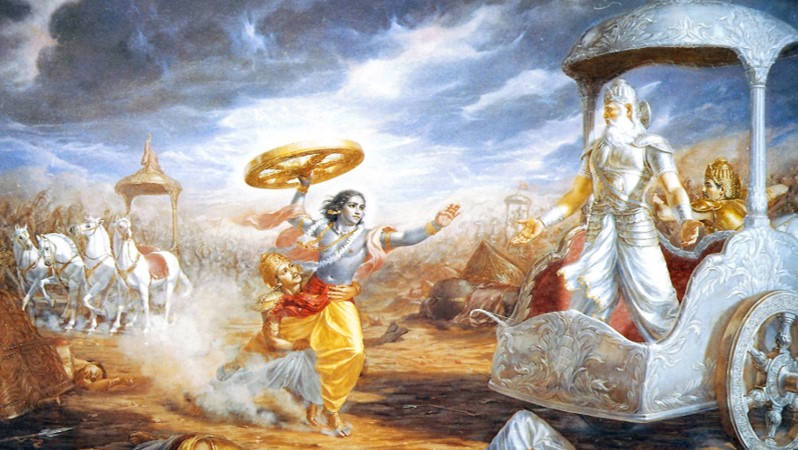
The acknowledgement from the United Nations was a good step in popularising and emphasizing the importance of yoga. But what it significantly establishes is that it is Indian heritage and India as the ‘home/owner’ of yoga and that it should be credited for birthing and nurturing it through the ages. Yoga is a prime example of what India has and continues to offer to the world. However while we celebrate this day, rejoice in its recognition, there are risks to watch out for. In the current times of west dominated globalization, it is important to be vigilant about the fact that India is fast losing control over the discourse of yoga. If not managed well, yoga may be downgraded as ‘secularized’ (a far inferior concept compared to sāpeksha dharma) and become ‘just science’, get arrogated to the westernized notional scheme and lose its linkage with its vital traditions of dharma. If that happens, yoga will lose a significant part of its essence and that will be a sad consequence for the whole of humanity. There are forces on both sides, some for Indian heritage and yoga and others against it, and the stage is set for the ‘Battle of Yoga’ in the Mahābhārata of civilizations.

Yoga has its roots in Indian heritage. The mainstay of our identity, or Indianness, is our heritage. While Abrahamic religions (specifically Christianity and Islam) have become quite prominent in recent history, the mainstream heritage of India is founded in Sanātana Dharma. Indians typically do not know that the paradigms of thought are very different in Sanātana versus the Abrahamic philosophy. While the differences between Abrahamic and Sanātana Dharma thought are numerous, at deep personal level, the idea of ‘self-realization’ is perhaps the fundamental one. Abrahamic philosophy stops at the idea of ‘belief’ and keeps the individual away from “God” forever. In Abrahamic philososphy, the idea of becoming one with God, like ‘Aham Brahmāsmi’ of Sanātana Dharma, is completely absent. According to Sanātana Dharma, every individual is inherently part of ‘Ēshwara’ and the task for an individual is to ‘realize’ it (not just believe it), through a journey of self-evolution. Yoga is one of Sanātana Dharma’s most prominent modes of self-realization, and as such integral to Sanātana philosophy. Its philosophy conflicts starkly with the Abrahamic conceptual framework.

Rajiv Malhotra’s work ‘Being Different’ contains a percipient representation of what constitutes the foundations of Indian heritage. Another excellent account of the origins and development of Yoga and its inextricable intertwining with various philosophical traditions originated in India, is the documentary ‘History of Yoga’ by Vishuddhi Films. It also brings out epigraphical evidences and provides a chronological perspective of yoga and its moorings in Indian heritage, which confutes the timeline assigned by major western scholars. A trailer of the film may be viewed here.

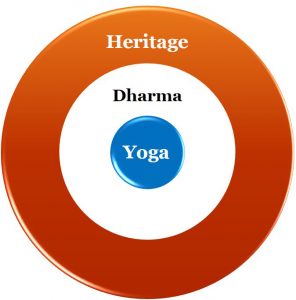
[Pic: YogadharmaHeritage]

Caption: Yoga as the Core of Hinduism/Sanātana Dharma, and Bhāratīya Heritage

Viewpoint – Good first step and Shankhnād for Mahābhārata of Civilizations:

Depending on one stands, there are multiple ways to look at any topic  – today it is IYD. In my view, IYD is a good first step in popularising yoga in our generation’s critical struggle in the service of our heritage. It is a sad fact that most Indians are not properly anchored in their own heritage. Reasons for this are many, from impact of British colonization to simply the unavailability of knowledge by means of formal/State approved education curriculum and knowledge distribution channels outside the state’s direct influence. Our minds have been so contaminated about the fundamentals on our own heritage, that it is almost impossible to get a common ‘story of India’ from any two Indians. Moreover, there has been and is even now, a significant intervention of anti-India forces to keep us divided, by heavy investments in the intellectual vehicles that influence the Indian mind. Anyone who would put on an analyst’s thinking cap would quickly realize that the Mahābhārata of civilizations has been a continuous phenomenon in history and will continue in the future. With high population and significant resources, and being a soft target, India today is the most important battleground of our lifetimes. It always makes me humble and solemn when I think about this battle at home, and we as the owners and carriers of Dhārmic heritage are not even aware of it (not most of us). The sad fact is that IYD saw the greatest resistance, not anywhere else in the world, but at home – inside India!

The Danger of Distortion, Digestion and Control over Discourse:

The linkage of yoga with Sanātana Dharma and pride of our heritage is severely under threat. It is consistently attacked by anti-India forces in overt as well as subtle ways. But what is still more dangerous; are the termites of well-meaning but ignorant intellectuals who stand under the banner of India/dharma loyalty that weaken us. In US, yoga is close to a $30 billion industry and only a negligible number of Indians (with loyalty to heritage) play any significant role in it. Most people in power positions are loyal to Abrahamic religions. It is not difficult to infer that, yoga in their hands is bound to be distorted, taken apart into pieces and digested, and this precisely the reason why the common mainstream narrative of yoga is secular and ‘scientific’ and removed from dharma. For those who are unaware of the context: the concept of secularism is relevant to the idea of religion, which is essentially Abrahamic. As religions are exclusive and interfered with political establishments, the concept of ‘secularism’ evolved as a solution to the problem of conflicts created by religion, which was not a bad thing in the backdrop of the cultures it was conceived in – in Abrahamic societies. In dhārmic ethos however, such a set of premises and exclusivist beliefs that classify it as religion does not exist. We had instead a universality of the human experience and oneness of being. In India there were panthas and sampradāyas, which were/are ‘paths’ that individuals identified with according to their unique nature and calling in life. And therefore the philosophy of yoga became an integral part of the bigger Sanātana Dharma complex and promoted this outlook, facilitated individuals in any capacity, every nature of engagement. Another question that is imperative to address is, ‘WHO’ should be allowed to represent yoga in public forums. The authority of yoga should always rest with competent people who expressly declare their allegiance to Bhāratīya heritage.

Swadharma cannot be outsourced to Government, a few organizations or intellectuals:

When it comes to civilization and heritage, we are all stakeholders. In my experience, it is a trend among Indian elites to escape responsibility by externalizing it and blaming everything on the State. Government is the caretaker of any nation. In a democracy we give the elected representative the responsibility to manage the country. Commonsense says that, we would not give our house keys to irresponsible people. The practical dynamics of politics does not always bring the best people in power. This is borne out only too patently if one looks at the people in power since India’s independence in 1947 and where they have got us. Even assuming the right people are in power, a politician’s first priority is always: to get in power and stay in power. This is why vote bank politics dominates the mind in Indian society today. The topic of heritage preservation is a subtle one, and often does not get prominence in this scenario where other competing practical issues (like self-gain and corruption) and political pressures take precedence. It is subtler, it is important but often is not regarded as urgent. Given these realities, we all have a role to play in service of heritage, dharma, nation (whichever of these words best conveys our feeling, the result of the endeavours in that direction will serve the same entity, eventually). Yes, Bhāratīya/dhārmic heritage is the longest continuing alive heritage today and it has been because our ancestors nurtured it with their lives quite literally. It is our turn now!

Wake up! This Mahābhārata will be intense because the world is now connected and information travels fast. Traditions are viewed negatively in popular culture, we have technology/ screens in our hands 24×7 to keep us distracted and in a state of inertia and oblivion. Unlike the freedom struggle where the British were a clearly identifiable enemy, in this battle we will be fighting our own brothers with brown skin and common heritage – because their mindsets and loyalty have shifted to the competitors’ side.

The big question is: how long we will stay in the confused state of mind – as Arjuna, in the beginning of the Mahābhārata?

Author: Sunil Sheoran

Published: June 20, 2015

September 22, 2021 0 comment
0 FacebookTwitterPinterestEmail

Fashion of India and Hinduism Bashing in Foreign Land

by ds_admin September 22, 2021

Context

Right in the middle of busy a work day (Wednesday, Oct 21st, 2015), I received an email from a friend about an India related event happening in my neighborhood. The event titled “Shattering the Silence: India’s Authors Protest Recent Murders”– An Evening with Ashok Vajpeyi, was hosted by Centre for South Asian Civilizations at University of Toronto. Simply knowing that most of the Centers of South Asian Studies are typically Anti-India/Anti-Hindu, it peeked my curiosity. I knew from the news headlines, that there is an anti-Modi campaign of intellectuals in India to return literary awards. Knowing about the Indian media’s bias against Hinduism, it made me wonder: How come someone is invited to University of Toronto, with such good timing. Who paid for travel expenses? Who are the anti-India, anti-Hinduism players in my town? With these thoughts, I moved around some items on my schedule to participate in the event.

While driving to the event I called my wife to do quick internet search on the speaker, Shri Ashok Vajpeyi. She gave me a 2-minute gist on his profile and the local organization hosting the event. I learned that he was one of the initial people who returned his Sahitya Akademi Award and he is an activist who’s linking Dadri lynching incident to suppression of freedom of speech of intellectuals in the country. He’s connected to leftist & Nehruvian-secularist mindset people and was close to Congress politician, Late Sh. Arjun Singh. I also called Shri Rajiv Malhotra, who has been my advisor in understanding the intellectual Kurukshetra. Rajiv Ji encouraged me to speak up my mind and be comfortable with the confrontation.

Although I expected it to be another anti-India/ Anti-Hindu event,

I went with more of a curious mindset to understand how these events get organized and what lessons I could learn. I’m sharing the learnings with people who care for Hinduism and who care for India, so that they are prepared a bit, as they come across similar scenarios.

Event Structure/ Format

The event was organized at University of Toronto, Mississauga campus at Instructional Centre, room 120. It was a typical auditorium style classroom setting, for 80-100 people or so. There was a formal reception, where attendees had to sign up/check in. Three cameras were placed at different angles to cover the event well, with a fancy looking multimedia set up. There were marked signs behind the cameras which instructed that, if people didn’t want to be on camera, they should sit behind these lines. It felt like, the event was set up to be nicely documented and promoted.

I went ahead and sat in the first row as I wanted to get engaged in the conversation. I knew people raising issue against the speaker will be discouraged and I will hardly get a minute or two, if lucky. So being close to speaker, I wanted the opposition from Dharmic-Patriotic side to be recognized on the camera. In front of the room, there were two nice chairs and a set of books that Shri Vajpeyi has published. The format was, that Shri Vajpeyi would give a speech, and then there would be a facilitated Question & Answer session.

The audience was a good blend – visually and ideologically. My guess is that about one-third people in audience were of Islamic representation (a couple specifically identified themselves as Pakistani), about same number were Caucasian – I’m assuming representing the Christian side (One professor of Christianity was identified). I’m guessing of the total of about 50 people, about one-third were in support of Dharmic ideology. As a pleasant surprise, 8-10 people in the audience were familiar faces, whom I had seen in other local Indian events.  It was nice to see, how many people of Dharmic ideology had independently heard about the event and came to the event at a short notice. Of these, 3 of us had participated in the workshop “How to be an Intellectual Kshatriya?” by Rajiv Malhotra. Being a university event, a good number of University students and staff were there. Shri Shafique Virani, was the host of the event.

Key Points of Ashok Vajpeyi’s Speech

Being a very experienced literary person, Shri Vajpeyi definitely has very good command over words and did a good job in presenting his views. This is besides the fact that he happens to be on the opposite side of Dharmic/ Hinduism ideology. Here’s my notes from his speech:

  • First thing Shri Ashok Vajpeyi established was that the killings in the country are not random, they are by design. So the whole pluralism and harmony of India is under threat.
  • Not only current harmony but the tradition of pluralism of India is under threat. He raised the issue that the established History is being questioned, and government seems to do it by design. E.g. An incompetent person, who hasn’t published a book is Chair of National Book Trust.
  • Intellectual freedom is under threat: He mentioned that it is battle of two ideologies. His ideology of democracy, secularism, pluralism of last 60 years, which is at heart of, what makes India great; is under threat and new narrow ideology is overtaking India. In the new environment all the intellectuals and thinkers are systematically pushed aside. They are being forced to write, think and dream in particular direction.

Shri Vajpeyi, branded Hinduism as some narrow ideology, dictatorship kind of thought which started making me very uncomfortable. In this messaging, he mixed positive thoughts sophisticatedly that we have a great tradition of doing Shastrarth and he specifically mentioned that leftists are not allowed to represent their ideology now. As he suggested that we should have open debate on intellectual issues, I was hoping that I will get to do a Shasthrath today with Shri Vajpeyi.

  • He clearly identified himself as upper caste Brahmin and gave his personal story of how his mother scolded/ slapped him when he called “Rehman uncle” as “Rehman.” With this, he introduced the idea of caste and the idea of victimhood for Muslims. He positioned himself to be “good-upper caste-liberal” Hindu; while working against Hinduism/ Dharmic ideology.
  • In a follow up discussion, he brought the issue of Dalit and Women, saying these are the two big groups that are on the brink of breaking down.
  • He questioned why “Aurangzeb Road” is renamed as “APJ Abdul Kalam Road.” Two points he connected was that history shouldn’t be questioned – so he supported Aurangzeb and attacked current government for the mindset that “see even a Muslim can be patriotic like Dr. Kalam.” – implying government assumes that all Muslims don’t care for the country.
  • He mentioned about a BJP Member of Parliament/ ministers are saying that Hindus should produce at least 4 children. He called himself a literary person, with political language throughout the speech.
  • He brought up the discussion of Gujrat Riots. Shri Vajpeyi attacked Prime Minister Narendra Modi, saying Modi equated Muslims to dogs. (The incident when a journalist asked a question to Narendra Modi, whether he feels sad about the people who died in riots. Modi Ji responded that, one feels sad even when a puppy dies accidently under your car; then how come I wouldn’t feel sad on the death of so many people.)
  • Then he connected what is happening in India to all the violent countries where Islamic terrorism is prevalent. Mentioned that religious violence in not happening only in India but religious violence is happening all over the world like Syria and other middle eastern countries. He equated India to those violence torn Middle-eastern countries.
  •  About workings of the government, he said while ministers are provoking and spreading the ideology of Hindu terror , and at the same time they provide lip service using standard political statements like we are operating within constitutional parameters.
  • Then he made mockery of spiritual leaders saying these Hindu religious Babas get arrested very frequently.  He said every time that happens, he feels spiritually happy “inside”. He said that I know it is an evil happiness but I enjoy it because it is happening to these evil people.
  • He mentioned that he does not have any political power. He is a writer and writers are lonely people but at this point in time writers have become the consciousness of the society . He simply wants the message of atrocity to spread out; as that’s all he can do. He wants to make everyone aware of the dangers that lie ahead if the current situation continues in India.
  • He closed with nice words that he hopes that India will come out triumphant and will uphold its great tradition of pluralism, democracy etc. etc…

Open Discussion after the Lecture

In Q & A session Shri Raj Maheshwari, whom I know from Intellectual Kshatriya workshop, was the first one to raise the concern. He very politely asked “It seemed more like a one-sided political speech, so please disclose your political affiliation.” To which Shri Vajpeyi very conveniently said that I am non-political person. I am in the field of literature and basically shirked the real question.

As Shri Raj Maheshwari had mentioned the idea of it being one sided story, someone from the audience pointed out that someone should present the other side of the story. That’s when I volunteered and offered to provide the overview of Dharmic ideology against which Shri Ashok Vajpeyi has delivered the whole speech.

The points that I mentioned were:

  • First of all, we need to understand that the story of India is anchored in Dharmic or Hinduism philosophy. Pick any of these interchangeable words. All the other ideologies like Islamic and Christian ideologies have later joined the national thought. So the new thoughts are merging with and attacking as well, the core, the Dharmic DNA of India.
  • There was no religious violence among Dharmic society until Islamic and Christian ideologies came to India. Because there is deep enlightened secularism or genuine secularism or pluralism is built into the philosophy of Sanatan Dharam or Hinduism. But in last 200 years or so, due to British colonialization our traditional way of Hinduism has been disrupted and our minds are colonialized, or at the least polluted and not anchored in Dharmic philosophy.
  • Secularism solves the problem of Islamic and Christian societies, by separating political and religious affairs. Secularism essentially is irrelevant in Hindu society because we have genuine secularism built into the Hindu philosophy, and wrong practice of secularism in India is creating unnecessary problems. The speaker is speaking against Hinduism and its degrading Hinduism to some narrow ideology.
  • India is perhaps the only country where is the history is written by colonizers and it still is taught in formal education. So we need a huge decolonization program throughout the country.
  • We’ve had bad governments since we got political freedom in 1947. It was bad because, it continued the British guiding thoughts and policies. With Nehru’s policies we didn’t go back to our root or traditional ideology or story of India anchored in Dharma. And that’s the side I want to present, which is opposite to the speaker’s thoughts.
  • With the current government, our hope is that they build the future of India, on our true heritage anchored in Dharma. We definitely don’t want the current government to be of some narrow exclusive ideology, which speaker today blamed them for.

With this introduction of alternative ideology to Shri Vajpayi’s; I also offered to provide counter-points to each of speaker’s arguments, if the forum is provided for “Shastrarth.” Which was obviously not possbile during that session.

In my heart, I thanked Mr. Shafique Virani, who did not interrupt me while presenting the Dharmic side; which was against his guest for the evening. With my comments the stage was essentially set for discussion to choose, one of the two sides, as opposed to giving the free pass to Shri Vajpeyi.

Interestingly, most of the people in the room who were in favor of speaker or against Dharmic ideology, kept quiet. Whereas, the people on our side of Dharmic thought, essentially took over the whole event.

Here’s some of the key questions/ comments from the open discussion:

Ravi Hooda, mentioned that the speaker’s lecture seemed like political rant. Being a man of literature, he should not create the bad taste. He questioned about timing of his event, and raised the issue that he shouldn’t question the credentials of his country’s appointees. He should not be passing judgement to other people not being qualified for positions given. Shri Vajpeyi’s awards can be questioned and his credentials can be questioned too.

Sujeev brought some good data that Ashok Vajpeyi is now returning award for one unfortunate incident while he had hosted the World Poetry Festival in December, 1984 when Bhopal was reeling under Union Carbide gas tragedy. Where was his insensitivity at that time?

According to article published at indiafacts.com when Vajpeyi was asked about it, Vajpeyi had shamelessly quipped, “मुर्दो के साथ रचनाकार नही मरता.” (The artist doesn’t die with the dead)

Similarly, few other people raised questions about his political alliance, and where his sensitivity was in 1984 or in Muzzafarnagar violence.

Somebody in the opposite side, criticized Manusmriti and brought up issue of Casteism. Fortunately, we had a Sanskrit speaking person Harsh Thakkar from Samskrit Bharati who gave a speech in Sanskrit which essentially mentioned that, to understand a text you should understand the language its written in; which is Sanskrit. He appealed that, as intellectuals we should not make comments on hearsay. He impressed everybody with his whole comment in Sanskrit itself and then translating it in English.

As a host, Shri Shafique Virani does deserve the appreciation, he moderated the event very professionally. While he was very respectful to the guest, Virani himself started good conversation by asking a question on behalf of opposing ideology. Additionally, when the Dharmic side folks asked the questions and presented their views, he provided them fair amount of time.

Key Takeaways/Lessons learned

  • Psychological toughness: One of the first lessons I learned was the need for psychological toughness. I went to the event with a calm mind, but as the Shri Ashok Vajpeyi packed so much anti-India, anti-Dharmic content in blunt yet sophisticated way; it wasn’t easy to stay calm. While the topic is very close to our hearts, we can’t get emotional and need to represent our ideology in these intellectual debates and discussions in controlled manner, by choosing right words, and right tone. Another key reason to have a tough mind is: In current popular culture/ mainstream thought, being western is “cool” and being traditional/Dharmic is not! So standing with Dharma means swimming against the current of pop-culture, it requires extra effort.
  • Training: Yes, I wasn’t very calm. I missed a few points and my message delivery wasn’t excellent – not up to my satisfaction. If that’s me, who’s been in the field for some years now with sincerity, anyone who wants to represent Hinduism in public/ against sophisticated opponents, needs training! If we, the representatives of Dharma want to serve it well, we can’t keep playing like amateurs where professionals have been practicing for long. I can’t over emphasize the need for training!
  • Team Matters: When I got to the event I saw many people who came there on a short notice. Although, I was ready to get engaged alone in the debate, seeing other people in room who I knew were on our wavelength helped. Many times, we talk about Hindus have hard time coming under one banner/ organization. To me, that’s a nice to have thing, the critical aspect is to anchor ourselves in Dharma with right understanding and training. In the event, although people representing Dharma weren’t from a specific organization, it was still great how intelligent comments complemented each other.  I can only imagine the days, when we start working in well-orchestrated teams and Dharma thought is represented effectively in service of India and in service of betterment of whole humanity.  We are definitely long way from that…
  • Format and who controls it: End of the day organizers control the format and record the event. This was just by luck that we got enough time to speak, otherwise if the format was little bit different, the outcome would not have been that successful. I’m guessing neither organizers, nor Shri Ashok Vajpeyi suspected participation of intellectuals from public. Assuming, the speaker and the organizers are a team, they would never allow the video of the event to be released. So it’s a good idea to record the video for record keeping. These days it’s so much easier with all the phones with audio-video capability. It’ll be interesting to see, whether the Centre for South Asian Civilizations will release the video of the FULL EVENT (Not just Shri Ashok Vajpeyi’s speech).  Currently, the opponents have unfair advantage, as Dharmic ideology people are don’t have fair representation in institutions that influence public opinion and policy making. As an example, Shri Vajpeyi wrote an opinion in Hindu (national newspaper in India, not be confused as pro-Hindu ideology), got invited to University of Toronto, Carleton University in Ottawa and got coverage in Globe and Mail, a national level Canadian newspaper. Do the people who represent Dharmic ideology get to leverage the knowledge dissemination institutions equally? Absolutely not!
  • We all matter: The topic of civilization and Dharma is so important at many levels and we can’t outsource the responsibility to some specialists. We are all stakeholders in it. I’m a busy professional, and along with taking care of my professional work and family responsibilities, I take time to learn and train myself to make contribution. Knowing some of the people in the room who confronted Shri Ashok Vajpeyi in this event, and connecting with others after the event; none were there for professional reasons. They were there for Dharma and nation.

It was interesting that once Shri Ashok Vajpeyi was confronted, he was completely quiet. It looked like the rug was pulled from under his feet, he was in awe, in shock. I wish the video of question and answer session comes out, with some focus on his reactions. My view is that Dharmic ideology is critical for the progress of our nation, and for broader good of the humanity. The narrow ideologies and shallow arguments can’t stand long, when we present our side logically, with right intentions and confidently.

I’m pretty sure, the word would be shared among the opponents camp (in Toronto area), and next time they’ll be better prepared to deal with surprise intervention from Dharmic side. At the same time, as we made our presence known in some circles, they’ll pause and think, before bashing India and Hinduism. With the initiative of a few committed individuals, it is not hard to create small teams of Dharmic intellectuals across major cities in North America… India?

To sum it up, get out of your comfort zone and do your share! Every contribution matters – big or small!

Author: Sunil Sheoran

Published: Oct 28, 2015

September 22, 2021 0 comment
0 FacebookTwitterPinterestEmail

Recent Posts

  • Why Swami Ramdev Deserves our Respect & Support?
  • Two Dharmic-Patriots & a Letter
  • Christmas Enthusiasm Among Hindus
  • Shankhanād for Mahābhārata of Civilisations – Reclaiming ‘Adhikāra’ Over Yoga
  • Fashion of India and Hinduism Bashing in Foreign Land

@2021 - All Right Reserved. Written by Sunil Sheoran


Back To Top
My Blog
  • Home